
What counts as an enterprise LLM, and why the decision matters
An enterprise LLM system is not defined by the size of the model. It is defined by governance: who owns it, what data it can see, how its outputs are checked, and what happens when it is wrong. A single engineer wiring a chat interface to a hosted API over a weekend is a prototype. The same integration becomes an enterprise system once it touches customer data, feeds a decision a customer or regulator will ask about, or runs continuously in front of real users.
That distinction matters because it changes the actual work involved. A prototype needs a working demo. An enterprise system needs an evaluation set, an access-control boundary, a logging and audit trail, a rollback plan, and someone whose job it is to answer for its behavior. Most of the effort in a real deployment goes into that governance layer, not into the model itself. This guide treats "enterprise LLM development" as building that governed system, whether the model underneath is a hosted API, a fine-tuned open-weight model, or, in rare cases, a model trained from scratch.
Before scoping any of this, it helps to know where general AI development services end and LLM-specific work begins. General AI development covers classical machine learning, computer vision, and forecasting as much as language models; the chapters that follow are specific to the parts of that discipline that involve generative language models making or supporting decisions inside a business process.
Where LLMs create verifiable value inside the enterprise
LLMs are useful inside a business when they replace a slow manual step with a faster one that a human can still verify, not when they replace a decision that requires accountability a model cannot carry. The table below groups the use cases that consistently justify a real build, based on what the system actually automates rather than a generic industry label.
| Function | Example use case | What the system actually does | Typical complexity |
|---|---|---|---|
| Internal knowledge and search | An assistant that answers employee questions from policy documents, runbooks, or product specs | Retrieves relevant passages and drafts an answer grounded in them | Low to medium: mostly a retrieval problem |
| Customer support | A first-line assistant that drafts responses or resolves common tickets | Classifies intent, retrieves account or product context, drafts or sends a response | Medium: needs guardrails against wrong account actions |
| Software engineering | Code review assistance, test generation, or migration support | Reads code context and produces suggestions a developer reviews before merging | Medium: value depends on integration into existing tooling |
| Sales and marketing content | Drafting first versions of proposals, briefs, or campaign copy | Generates a draft from structured inputs; a human edits and approves | Low: output is never sent without review |
| Document and back-office processing | Extracting structured data from contracts, invoices, or claims forms | Extracts and classifies fields, flags exceptions for human review | Medium to high: accuracy requirements are stricter |
To make the rest of this guide concrete, it follows one running example: Meridian, a hypothetical mid-size insurance company evaluating an internal assistant that helps claims adjusters find relevant policy language and prior claim decisions. Meridian is not a real Apptechies client; it is used here only to keep the architecture, cost, and evaluation chapters connected to one coherent scenario instead of a new example every few paragraphs.
Meridian’s use case sits in the internal knowledge and support category, which is usually the easiest starting point because a wrong answer is caught by a reviewer before it reaches a customer. This kind of assistant is typically delivered as a retrieval-augmented application; a fully autonomous customer-facing agent, delivered through AI agent development services, carries materially more risk because there is no reviewer in the loop before the output reaches a customer, and it deserves a stricter evaluation bar than the chapters below describe for an internal tool.
Buy, customize, or build: choosing the right approach
There are three real options, and they are not equally common in practice.
Using a hosted API means calling a provider’s model (OpenAI, Anthropic, Google, or others) directly, optionally adding retrieval and prompt engineering around it, with no changes to the model’s own weights. Fine-tuning means adjusting an existing model, hosted or open-weight, on your own examples so it performs a narrower task more reliably or in your own voice. Pretraining from scratch means training a new foundation model on a large general corpus before any task-specific adjustment, which is what "building an LLM" means in the strict, original sense of the phrase.
Some vendor guides present these three as comparably priced options a few tens of thousands of dollars apart. They are not. Publicly reported pretraining runs for competitive foundation models cost from tens of millions to hundreds of millions of dollars in compute alone, before data licensing, research staff, and evaluation. Unless your organization is a model vendor or has a genuinely unique data asset and multi-year AI research mandate, pretraining is not a real option for a business application, and treating it as a "build" cost in the same range as fine-tuning sets an unrealistic budget expectation. For the overwhelming majority of enterprises, "build" in practice means the second option: fine-tuning, usually combined with retrieval, not full pretraining.
| Approach | Speed to a working system | Data privacy and control | Customization ceiling | Main ongoing cost driver | When it fits |
|---|---|---|---|---|---|
| Hosted API, no fine-tuning | Days to a few weeks | Data leaves your infrastructure per the provider’s terms unless a private-deployment option is used | Limited to prompting and retrieval | Per-token inference cost | Fast pilots, uses where provider terms and data residency are acceptable |
| Fine-tuning an existing model | Weeks to a few months | Can be scoped to your own infrastructure with open-weight models | Higher: model adapts to your domain language and format | Training compute plus ongoing inference | Recurring, well-defined tasks where accuracy or tone matters more than generality |
| Pretraining a foundation model | Many months to years | Full control by construction | Highest in theory, rarely realized in practice for a single business use case | Massive upfront compute and research staffing | Model vendors and a small number of organizations with a unique, large-scale data advantage |
Scoring your own constraints against this table is more reliable than picking the option that sounds most advanced. This guide’s toolkit includes an approach scorecard you can fill in with your own weights for data sensitivity, customization need, time to value, and total cost of ownership. The table below shows the filled example’s result for Meridian, whose insurance-sector data residency requirement makes data sensitivity the highest-weighted criterion.
| Criterion | Weight | Hosted API score | Fine-tuning score | Pretraining score |
|---|---|---|---|---|
| Data sensitivity fit | 25 percent | 2 | 5 | 5 |
| Customization need | 20 percent | 2 | 4 | 5 |
| Time to value | 20 percent | 5 | 3 | 1 |
| Total cost of ownership | 20 percent | 4 | 3 | 1 |
| In-house ML talent required (lower burden scores higher) | 15 percent | 5 | 2 | 1 |
| Weighted total | 100 percent | 3.45 | 3.55 | 2.80 |
For Meridian, fine-tuning narrowly outscores the hosted API, mainly because of the data sensitivity weighting, and pretraining is clearly ruled out. A different weighting, for a company without a strict data residency requirement, could easily favor the hosted API instead; the point of the scorecard is to make that trade-off explicit rather than assumed. The full worksheet and blank template are in this guide’s toolkit.
For most first deployments, starting with AI consulting services to validate the use case before committing engineering time is cheaper than discovering the wrong approach mid-build. Once fine-tuning is the likely path, the practical next step is usually to hire an LLM developer with direct experience running that specific workflow, rather than treating it as a generic software engineering task. If your organization genuinely believes pretraining is warranted, that decision deserves independent scrutiny; generative AI consulting services can pressure-test that assumption before it turns into a multi-year commitment.
Reference architecture for an enterprise LLM system
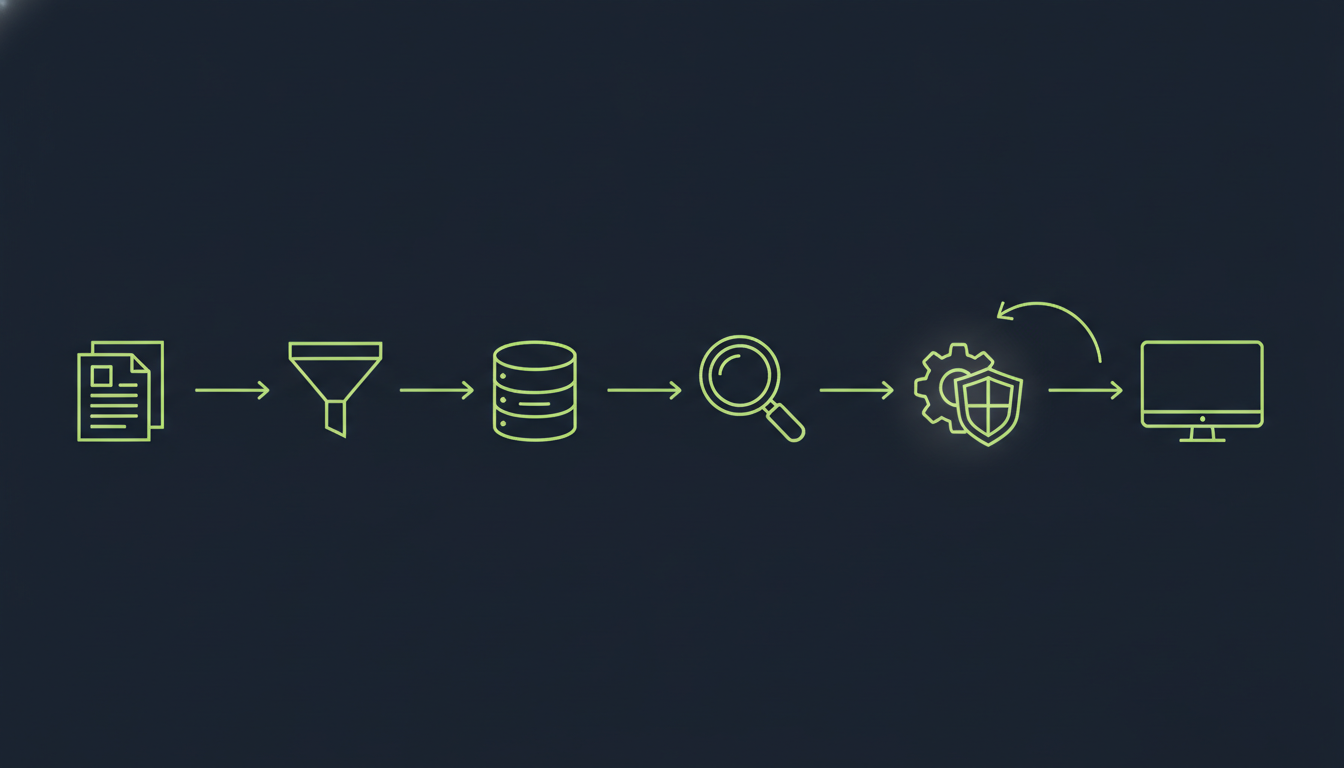
Whether the model is a hosted API or a self-hosted open-weight model, a production enterprise LLM system has the same three layers.
Data and retrieval layer
Source documents (policies, tickets, product data, prior decisions) are ingested, split into chunks, converted into embeddings, and stored in a vector database. At query time, the system retrieves the most relevant chunks and passes them to the model as context. For Meridian, this layer ingests policy documents and historical claim notes, re-indexing on a schedule as new documents are added. Building this layer well is usually the difference between a system that gives grounded answers and one that hallucinates; it is a genuine engineering discipline, delivered through RAG development services, and staffed in practice by choosing to hire a RAG developer rather than assuming any backend engineer can assemble it correctly on the first attempt. Feeding this layer at enterprise document volume is a data analytics services and, for genuinely large corpora, a big data services problem before it is a model problem.
Orchestration and guardrails layer
This layer assembles the final prompt from the user’s question, retrieved context, and system instructions; calls any tools the model is allowed to use (a claims lookup API, for Meridian); and filters the model’s output before it reaches the user, checking for disallowed content, unsupported claims, or actions outside the system’s permitted scope. Frameworks like LangChain or comparable orchestration tooling are commonly used here, which is why teams building this layer for the first time often choose to hire a LangChain developer rather than write the retry, tool-calling, and guardrail logic from zero.
Model layer
This is the LLM itself, called through a hosted API or run on self-managed infrastructure if data residency or latency requirements demand it. The model layer is the easiest to swap later if the interfaces above it are well defined, which is one more reason not to over-invest in the model choice at the expense of the retrieval and guardrail layers around it.
On-premises, cloud-hosted, or hybrid: where should it run
The buy, customize, or build decision is separate from where the system physically runs, and vendor guides often conflate the two. A fine-tuned model can run on a managed cloud service or on your own infrastructure; a hosted API call can originate from a fully on-premises application. The table below separates the two decisions.
| Deployment model | Does data leave your infrastructure | Operational burden | Typical fit |
|---|---|---|---|
| Fully hosted API | Yes, per the provider’s data handling terms | Low: no model infrastructure to run | Fast pilots and use cases where provider terms and residency are acceptable |
| Self-hosted open-weight model | No, if run entirely on your own or a private cloud environment | High: your team owns GPU capacity, scaling, and model updates | Strict data residency requirements or workloads with sustained, predictable volume that justify the fixed infrastructure cost |
| Hybrid: on-premises retrieval, hosted model call | Only the retrieved context and the question leave your infrastructure, not the full document store | Medium: retrieval infrastructure is yours, model operations are the provider’s | The common middle ground when raw documents must stay in-house but a small amount of retrieved text in an API call is acceptable |
For Meridian, a hybrid model is usually the practical answer: policy documents and claim records stay in Meridian’s own environment, and only the specific retrieved passages needed to answer one question are sent to a hosted model call. This satisfies most data residency requirements without taking on the operational burden of hosting the model itself. A stricter regulatory requirement that prohibits sending any customer data externally, even in a single API call, would push the decision toward a fully self-hosted open-weight model instead, at the cost of the operational burden that comes with it.
Phased delivery plan: from scope to production
Enterprise LLM projects fail more often from skipped phases than from a wrong model choice. The phases below apply whether the underlying approach is a hosted API or a fine-tuned model.
| Phase | Inputs | Responsible role | Work | Output | Acceptance condition |
|---|---|---|---|---|---|
| Discovery and scoping | Business goal, target users, constraints | Product owner and technical lead | Define the use case, success metric, and out-of-scope behavior | Scope document and success metric | Stakeholders agree on what "working" means before any code is written |
| Data readiness | Source documents or systems | Data engineer | Assess data quality, access rights, and freshness; build the ingestion pipeline | Indexed, access-controlled data source | Retrieval returns relevant results on a sample of real questions |
| Build | Architecture decision, indexed data | AI/ML engineer, backend engineer | Build orchestration, guardrails, and the application interface | Working system in a staging environment | System runs end to end on the evaluation set without crashing |
| Evaluation | Working staging system | Evaluation lead, subject-matter reviewer | Run the evaluation set, red-team for failure modes, measure latency and cost | Evaluation report against go-live criteria | Every go-live criterion in the next chapter is met or explicitly waived by an accountable owner |
| Security and compliance review | Evaluation report, data flow diagram | Security and legal/compliance reviewer | Confirm data handling, access boundaries, and applicable regulatory obligations | Sign-off or documented remediation plan | No open high-severity finding at launch |
| Deployment and operation | Signed-off system | Platform/DevOps engineer, product owner | Deploy, monitor, and assign an on-call owner | Live system with monitoring and rollback plan | Rollback path tested before the first real user session |
Connecting the system to existing internal tools (a claims database, a CRM, a ticketing system) is usually the most underestimated part of the build phase; this is genuine AI integration services work, not a configuration step. Provisioning the environment it runs in, especially if data residency requirements rule out a shared multi-tenant hosting option, is an infrastructure decision that should be made during discovery, not after the build phase is underway.
Evaluation and go-live criteria
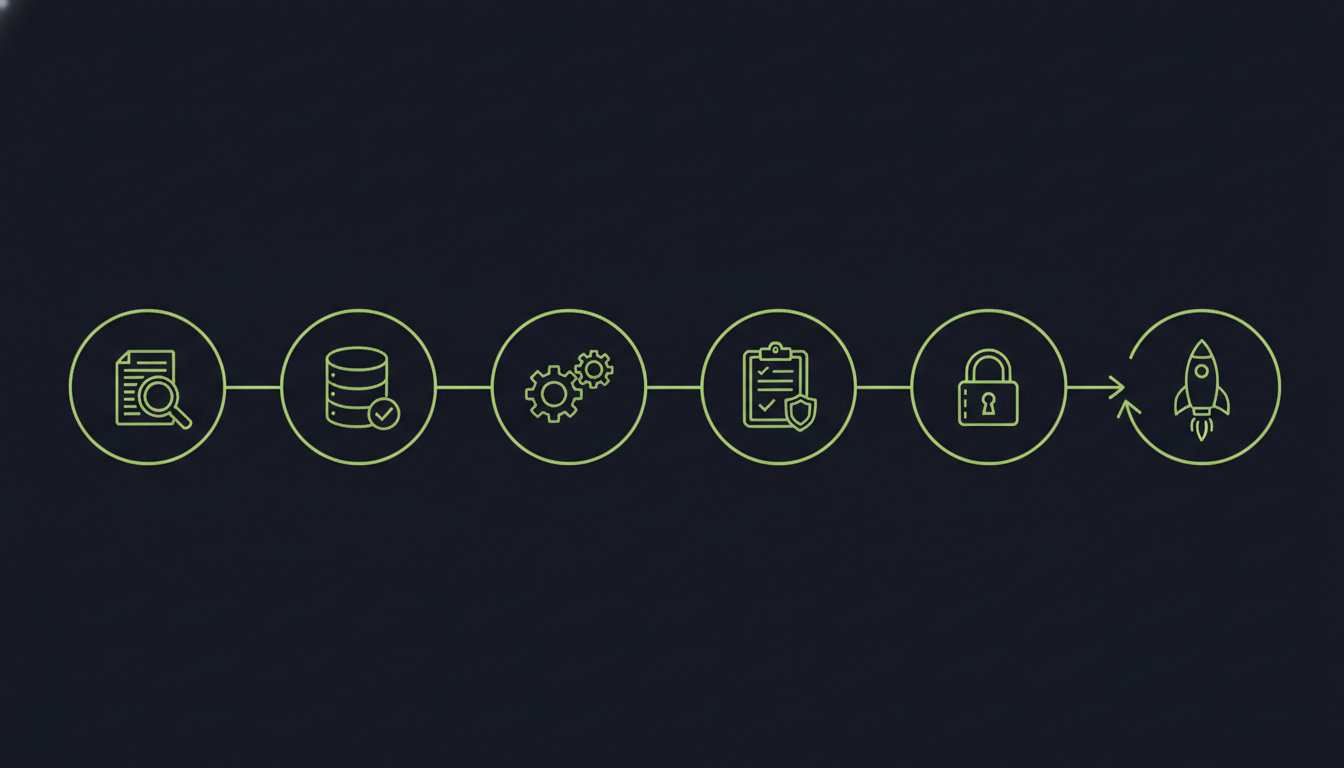
An enterprise LLM system is ready to launch when it passes explicit, measurable criteria, not when it "seems to work" in a demo. Build the evaluation set before the build phase finishes, using real questions or documents from the target workflow, held out from anything used during development or fine-tuning.
At minimum, check the following before any go-live decision:
- Task accuracy against the held-out evaluation set, measured against a labeled correct answer or an acceptable answer range, not a subjective read.
- Faithfulness of retrieval-grounded answers: the rate at which the system’s claims are actually supported by the retrieved context, not invented.
- Latency at the 95th percentile under expected concurrent load, not just average latency on a single test query.
- Cost per request at expected production volume, calculated from actual token usage on the evaluation set, not an assumption.
- A red-team pass covering prompt injection through untrusted documents, attempts to extract system instructions, and requests for actions outside the system’s intended scope.
- A named accountable owner who signs off on the launch and owns the system’s behavior afterward.
The table below shows illustrative go-live thresholds for Meridian’s internal claims assistant; treat the actual numbers as a starting point to adapt, not a universal standard, since acceptable thresholds vary with how much harm a wrong answer can cause.
| Criterion | Metric | Illustrative target for an internal assistant | How it is measured |
|---|---|---|---|
| Task accuracy | Percent of evaluation questions answered correctly | 90 percent or higher | Manual grading against a labeled evaluation set |
| Faithfulness | Percent of claims supported by retrieved context | 95 percent or higher | Manual or model-assisted review comparing answers to retrieved sources |
| Latency | 95th percentile response time | Under 4 seconds for an internal tool | Load test at expected concurrent usage |
| Cost per request | Average token cost per query | Within the budget set during the cost-model chapter | Calculated from evaluation-set token usage |
| Red-team pass | Number of unresolved high-severity findings | Zero | Structured adversarial testing before launch |
This guide’s toolkit includes a filled evaluation and acceptance checklist you can adapt; treat any unmet criterion as a blocker unless an accountable owner explicitly waives it in writing, not as a note to revisit after launch.
Cost model: what an enterprise LLM program actually costs
Two separate costs matter, and vendor cost tables often blur them together: the one-time build cost, and the recurring lifecycle cost once the system is live.
Build estimate = sum of (role hours x hourly rate) + one-time external costs + stated contingency. Lifecycle cost = build estimate + recurring fixed costs + usage costs over the stated period.
The worked example below models Meridian’s claims-support assistant: a retrieval-augmented application with light fine-tuning, delivered in roughly 12 to 14 weeks. Every figure is an editorial, illustrative estimate built from this formula, not an Apptechies quote or a verified market average; recalculate it with your own rates and volumes before using it in a real budget.
| Role | Estimated hours | Hourly rate (USD) | Subtotal |
|---|---|---|---|
| Discovery and scoping | 60 | 90 | 5,400 |
| Data engineering | 200 | 75 | 15,000 |
| AI/ML and retrieval engineering | 260 | 95 | 24,700 |
| Backend and platform engineering | 220 | 80 | 17,600 |
| Evaluation and red-teaming | 120 | 85 | 10,200 |
| Security and compliance review | 60 | 100 | 6,000 |
| Project management | 100 | 70 | 7,000 |
Total estimated hours: 1,020. Subtotal: 85,900 US dollars. Adding one-time external costs of 8,000 US dollars (vector database setup and an external red-team engagement) and a 15 percent contingency of 12,885 US dollars on the subtotal gives a build estimate of 106,785 US dollars. The full arithmetic check is reproduced in this guide’s supporting data files.
Recurring lifecycle costs depend mainly on request volume, not on which model family you choose, once you have picked a reasonable tier. Using Anthropic’s currently published Sonnet 5 pricing of 2 US dollars per million input tokens and 10 US dollars per million output tokens, a system handling 500,000 queries a month at roughly 800 input tokens and 300 output tokens per query costs approximately 800 US dollars in input tokens and 1,500 US dollars in output tokens, or about 2,300 US dollars a month in inference. Vector database hosting and observability tooling at that scale typically add another 500 to 1,500 US dollars a month, depending on data volume and retention. At this volume, engineering and governance work, not token cost, is almost always the larger line item over a system’s first year; this is the opposite of what many cost tables imply by leading with per-token pricing.
For a broader view of AI project costs beyond LLM-specific work, see our guide to AI development cost. If staffing is the main open question rather than the architecture, cost to hire AI developers breaks down that side of the budget separately.
Security and data governance
Data boundaries and residency
Decide, before any build work starts, whether data can leave your infrastructure to reach a hosted API, and under what contractual terms. Some providers offer options that exclude submitted data from model training; verify this in the provider’s current terms rather than assuming it, since terms change between model versions.
Access control and audit
The system should only retrieve documents the requesting user is already authorized to see; retrieval must respect existing permission boundaries, not bypass them because the model is "just answering a question." Every request and response should be logged with enough detail to reconstruct what the system saw and said, for both debugging and audit purposes.
Vendor and model risk
Treat the underlying model as a dependency with its own risk profile: providers deprecate models, change pricing, and update model behavior between versions. Document which model version is in production and test before upgrading, the same discipline you would apply to any other critical dependency. Infrastructure hardening for the environment the system runs in, especially for a self-hosted or hybrid deployment, is a cloud security services concern separate from the model choice itself, and how to choose an AI model for production covers the model-selection side of this in more depth than this chapter does.
Regulatory and compliance timeline
Regulatory obligations depend on jurisdiction and on what the system actually does, not on the fact that it uses an LLM. The table below reflects verified current dates as of this guide’s publication; verify the current status before committing a launch date to it, since several of these dates have already moved once.
| Framework | Applies to | Key obligation | Current status and date |
|---|---|---|---|
| EU AI Act, prohibited practices | Any AI system available in the EU market | Bans systems like social scoring and manipulative AI outright | In force since 2 February 2025 |
| EU AI Act, general-purpose AI model obligations | Providers of general-purpose AI models (most foundation model providers) | Documentation, copyright, and systemic-risk obligations for model providers | In force since 2 August 2025 |
| EU AI Act, high-risk systems under Annex III | Use-case categories such as employment, essential services, and biometric identification | Risk management, data governance, technical documentation, logging, and conformity assessment | Deferred by the 2026 Digital Omnibus agreement to 2 December 2027 |
| EU AI Act, high-risk systems under Annex I | AI embedded in regulated products (medical devices, machinery, and similar) | Same obligations as Annex III, tied to existing product-safety regimes | Deferred to 2 August 2028 |
| NIST AI Risk Management Framework, Generative AI Profile | Any organization, voluntary, primarily referenced in the United States | Risk identification and mitigation across four functions: Govern, Map, Measure, Manage | Framework published January 2023; Generative AI Profile (NIST-AI-600-1) published July 2024, both voluntary |
Meridian’s claims assistant, as described in this guide, assists a human adjuster rather than making an autonomous claims decision, which is a meaningfully different risk category from an autonomous underwriting or claims-denial system under most current frameworks; do not assume every insurance use case sits in the same risk tier without checking the specific decision the system makes.
Common failure modes and how to test for them
Hallucination under distribution shift: the system answers confidently about a topic outside its retrieved context or training data. Test by including evaluation questions deliberately outside the system’s intended scope and confirming it declines or flags uncertainty instead of guessing.
Retrieval returning stale or irrelevant context: the vector store was not re-indexed after source documents changed. Test by updating a source document and confirming the system’s next answer reflects the change within the expected refresh window.
Prompt injection through untrusted documents: a retrieved document contains instructions aimed at the model rather than the user. Test with documents that deliberately attempt to override system instructions.
Cost runaway from unbounded context: a change in usage pattern (longer documents, more concurrent users) multiplies token cost unexpectedly. Test by simulating peak load and confirming cost per request stays within the budget set during evaluation.
Over-reliance without a human fallback: users stop verifying outputs because the system is usually right. Mitigate with visible confidence signals and a designed escalation path, not just an assumption that users will stay vigilant. Many of the generative features described in generative AI features for apps share this same risk and are worth reviewing for the same failure pattern.
Model deprecation breaking the integration: a provider retires the model version in production. Mitigate by monitoring provider deprecation notices and testing the replacement model against the same evaluation set before switching.
Operating the system after launch
Monitoring and drift detection
Track accuracy against a rolling sample of real production interactions, not only the original evaluation set, since real usage patterns drift from what was tested. Alert on latency, error rate, and cost per request the same way you would for any production service.
Change management and rollback
Every prompt change, model version change, or retrieval configuration change should go through the same evaluation set used at launch before reaching production, with a tested path to roll back to the previous configuration. This operational discipline is standard DevOps services practice applied to a system whose behavior is harder to unit test than traditional code.
Decommissioning
Plan for the system’s end of life as deliberately as its launch: how data is retained or deleted, how users are migrated to a replacement, and how access is revoked. If usage outgrows the original infrastructure choice, cloud migration services can move the system to infrastructure that matches its actual scale rather than the pilot-stage assumption it was built on.
Choosing an implementation partner
If the work will not be done entirely in-house, evaluate a partner on evidence, not on how confidently they describe the technology. Watch for these signals before signing anything:
- Cannot describe a specific evaluation methodology beyond "we tested it and it works."
- Presents pretraining a foundation model as a routine option without addressing its real cost.
- Has no answer for what happens when the underlying model provider deprecates a model version.
- Treats data governance and security review as an afterthought scheduled after the build is complete.
- Cannot separate build cost from recurring lifecycle cost in their own proposal.
A partner capable of this work should be able to speak to the full discipline covered in this guide, from architecture through machine learning development services more broadly, not only prompt engineering. Apptechies has shipped real generative AI products, including MyMood AI, a consumer generative AI platform; that experience with production generative AI systems, not a claimed enterprise LLM case study, is the honest basis for the capability described in this guide.